Showing posts with label contempt of court??. Show all posts

Saturday, December 20, 2008

Report, photos & videos of Roo Boys' release from Queenstown Remand Prison

More photos here

The latest Hooray
Singapore Democrats, 19 Dec 2008


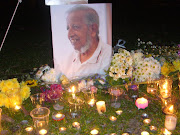
A candlelight vigil was held on the night of 17 Dec 08, the last night of Mr Isrizal's and Mr Shafi'ie's prison sentence.

More than 30 friends, family, activists and supporters came to the vigil which stretched through the night as they awaited the release of the two men. Mr John Tan started serving his sentence on 16 Dec and will be released on 30 Dec 08.

Candles were lit and lined the kerb facing the main gates of the Queenstown Remand Prison. By midnight, there were just five who were able to stay through the night. But they were not alone as messages of support and pledges of solidarity had been penned on a large placard. SMSes of the same spirit were received throughout the night.

A vigil is a kind of purposeful sleeplessness – the Latin root, vigilia, denotes "watch, watchfulness, wakefulness". Traditionally used in an ecclesiastical sense to describe a devotional exercise performed on the eve of a festival or holy day, in this instance it was a night to devote attention to our three prisoners of conscience.

Famously dubbed as the "kangaroo t-shirt trio", the contempt of court charges were brought against them by the Attorney-General who insisted that he took action in his capacity as the "Guardian of the Public Interest".

As a public interest issue, the question remains if this was the best course of action to take against three citizens for wearing t-shirts which bore an image with no words.

The night was cool and the air still. Sound carried from the guardhouse behind the gates. At one point, late into the night, the guard could be heard reporting on the vigil: "One was 'doing arts-&-craft', the others chatting whilst another was 'looking at the stars', etc." The arts-&-craft activity was in reference to the making of a "Welcome Back" sign.

A song* (see below) was written and rehearsed, sung tongue-in-cheek to the tune of Amazing Grace, to greet the two.

Morning came and supporters and well-wishers arrived to greet the two as the time of release neared.

At around 10 am, Mr Shafi'ie emerged. He strode to the gates, calm, composed and dignified. He was garlanded and warmly hugged. He was also presented with a booklet, a compilation of articles about his valour and strength in the face of such difficulty, especially at such a young age. The song was performed with gusto and to much laughter.


Mr Isrizal appeared soon after (at about 10.30 am). Upon exiting the prison, he punched the air shouting "Merdeka!" The same welcome was extended and he was also garlanded, hugged and "serenaded".


*Song lyrics

Oh Shafi'ie and Isrizal,
For seven days, you were jailed
Because of _ _ _ and _ _ _ _ _ _ _ _ _ _ (**)
And a single kangaroo

And now you're back with us today
We hope you enjoyed your stay
But John's still inside this afternoon
And the rest will join in, soon

Hip Hop Hooray
Hip Hop Hooray
Hip Hop Hooray Hooray

Hip Hop Hooray
Hip Hop Hooray
Hip Hop Hooray today

**Play hangman. Fill in the blanks at your own peril.

Sunday, November 30, 2008

Singapore (government) strikes again: Wall Street Journal

Singapore Strikes Again
Wall Street Journal, 29 Nov 08


The city-state resumes its campaign against the Journal.

Let us begin with an apology to our readers in Asia. Unless they are online, they will not see this editorial. For legal reasons, we are refraining from publishing it in The Wall Street Journal Asia, which circulates in Singapore.

Our subject is free speech and the rule of law in the Southeast Asian city-state -- something on which the international press and Singapore's government have often clashed. We can't say which side would prevail if the Singapore public could hear an open debate, but the fact is that we know of no foreign publication that has ever won in a Singapore court of law. Virtually every Western publication that circulates in the city-state has faced a lawsuit, or the threat of one.

Which brings us to the ruling against us this week in Singapore's High Court. Dow Jones Publishing (Asia) was found guilty of contempt of court for two editorials and a letter to the editor published in The Wall Street Journal Asia in June and July. The Attorney General, who personally argued the contempt case against us, characterized the articles as "an attack on the courts and judiciary of Singapore inasmuch as they impugn the integrity, the impartiality and the independence of the Court."

In suing for contempt, Singapore chose to go after us for the most basic kind of journalism. The first editorial, "Democracy in Singapore," reported on a damages hearing in a defamation case brought (and won) by former Prime Minister Lee Kuan Yew against opposition politician Chee Soon Juan. The second editorial, "Judging Singapore's Judiciary," informed readers what an international legal organization had said about Singapore's courts.

Regarding the first editorial, we'll note that court proceedings are privileged under Singapore law, which means they can be reported -- though Singapore's media rarely do the job. Mr. Chee wrote a letter in response to the first editorial, which we published and which is cited in the contempt charge. We also published two letters from Mr. Lee's spokeswoman.

In the second editorial, we reported on the International Bar Association's critical study of the rule of law in Singapore. This is the same outfit that held its annual conference in Singapore last year, a meeting that Mr. Lee himself touted as a sign of confidence in Singapore's courts. The Law Society of Singapore is a member of the IBA. If reporting on what such a body says is contemptuous of the judiciary, then Singapore is saying that its courts are above any public scrutiny.

Again, we published a letter from the Singapore government responding to the editorial. This one was from the Law Ministry, which blasted the IBA report and us for repeating its "vague allegations." The IBA then weighed in, in a posting on its Web site, saying it wished "to correct some inaccurate comments" in Singapore's letter. It invites readers to read the report and "see for themselves" that its views are "based on comprehensive examples and evidence." The IBA homepage is www.ibanet.org.

In his ruling, Justice Tay Young Kwang refers to us as a "repeat offender." He's right in the narrow sense that this isn't the first time Singapore has pursued the Journal Asia for contempt. In 1985, the newspaper and its editors were sued over an editorial about legal actions against opposition politician J.B. Jeyaretnam. The editors apologized.

In 1989, the paper was sued for contempt again, this time over a news story that quoted Dow Jones's then-president, Peter Kann. Mr. Kann had criticized a libel judgment won by Mr. Lee against the Far Eastern Economic Review, the Journal Asia's sister publication. The paper, its editor, publisher, local distributor and local printer were all named. They lost.

We are not eager to return to that fractious era, when the Journal Asia had its circulation severely restricted in Singapore and the paper's reporters were unwelcome. Since 1991, when the newspaper and Mr. Lee reached a settlement, our relationship with Singapore had been more or less stable until the latest contempt charge.

Meanwhile, in September, the Far Eastern Economic Review lost a defamation case brought by Mr. Lee and his son, current Prime Minister Lee Hsien Loong, over an interview it published with opposition leader Mr. Chee. The elder Mr. Lee has long used defamation suits to silence his critics in the press and among the political opposition.

As for this week's contempt ruling, the first line of Justice Tay's decision is revealing as a standard for Singapore justice. "Words sometimes mean more than what they appear to say on the surface," he writes, going on to interpret the words as contemptuous because they had an "inherent tendency" to "scandalise the court." The fine he levied, S$25,000 ($16,500), is the largest ever meted out for such an offense. Justice Tay expressed the hope that it will deter "future transgressions."

We'll pay the fine. We'll also continue to express our views about politics, the courts and other subjects that we think our readers should know about. And we'll let readers decide what to make of the judiciary in Singapore.

Singapore Wins Again
Asia Sentinel, 26 Nov 08


A high court judge reinvents Alice in Wonderland in a contempt case

As expected, a Singapore high court judge has once again ruled against a western news organization, in this case the Wall Street Journal Asia, for contempt of court for three articles published in June and July that “impugn the impartiality, integrity and independence of the Singapore judiciary,” according to the complaint.

The court fined Dow Jones Publishing Co. S$25,000, said to be the highest amount ever levied for such a case, according to the Wall Street Journal. "Dow Jones is extremely disappointed with the ruling of the High Court and strongly disagrees with the court’s analysis that the editorials and letter to the editor constitute contempt of court," a Dow Jones spokesman said. "Also, contrary to what the attorney general has alleged, The Wall Street Journal Asia has not engaged in a ‘campaign’ of any sort against the Singapore judiciary. We will in the future continue to defend the right of The Wall Street Journal Asia to report and comment on matters of international importance, including matters concerning Singapore."

The 43-page judgment, written by High Court Judge Tay Yong Kwang, contains some startling language in its attempt to pin contempt charges on the newspaper, its editor, Daniel Hertzberg, managing editor Christine Glancey, and Dow Jones Publishing Co., now owned by Rupert Murdoch’s News Corp. In effect, Tay said, there were no actionable words in the articles. But, he wrote:

“Words sometimes mean more than what they say on the surface. This proposition is a recurring theme in the present proceedings before me, which concerns an application for by the Attorney General for orders of committal for contempt against [the] three respondents...”

And, as part of the background of the case, Tay wrote: “As will be demonstrated shortly, it is not the AG’s case that the publications contained passages or words that expressly scandalize the Singapore judiciary, but that they do so by implication, especially when the offending passages or words of each publication are read in the context of that individual publication.”

In other words, any publication deemed by Singapore to have been hostile to Singapore in the past could find itself in the dock without using “passages or words that expressly scandalize the Singapore judiciary” or presumably the family of ageing patriarch Lee Kuan Yew, the country’s minister mentor.

The court, however, is about as touchy as the Lee family. In October, three supporters of the opposition Singapore Democratic Party were promptly arrested when they turned up at Singapore’s Supreme Court wearing T-shirts depicting a kangaroo in judicial robes. The three, 19-year-old Muhammad Shafi'ie Syahmi Sariman, 33-year-old Isrizal Mohamed Isa and 47-year-old John Tan Liang Joo, were convicted and were to be sentenced November 27 for contempt of court.

Reporters Without Borders condemned the Wall Street Journal ruling, saying that "Even if the fine is not colossal, the ruling very clearly shows that Singapore's judges have no intention of letting the foreign media express themselves freely about the country's judicial system, which is lacking in independence."

As to the Journal case, it is hardly the first time Singapore has found the western press wanting, or used tortured language to go after them. The lawsuit-happy Lee family has filed a plethora of defamation lawsuits and contempt charges repeatedly against Dow Jones publications, particularly the Far Eastern Economic Review and the Asian Wall Street Journal, now known as the Wall Street Journal Asia, as well as Time Magazine, the Economist, the International Herald Tribune and many more.

In 2007 for instance, the Financial Times issued a hasty apology and paid undisclosed damages for a story in which there appeared to be no libel. The article dealt with the growth of so-called sovereign wealth funds, particularly a new Chinese fund that was unveiled at the end of September, and referred to growing concern over the acquisition of strategic industries by funds controlled by governments in Asia and the Middle East. At the end of the piece, the author referred to Temasek, the increasingly troubled Singapore state investment fund, and described some of the problems Temasek has faced with the fallout from the fund's acquisition last year of Shin Corp, the Thai telecoms group owned by former Prime Minister Thaksin Shinawatra, which ultimately contributed to Thaksin’s downfall. At the end of the article, the author referred to the fact that Temasek is run by Ho Ching, the wife of Prime Minister Lee Hsien Loong, and concluded with these words:

“DBS Bank, whose biggest shareholder is Temasek, this week surprised many by announcing that US-born Jackson Tai would step down towards the end of the year. Mr Tai was said to be keen to ‘spend more time with his family.’

“Last week Jimmy Phoon, Temasek's chief investment officer, announced he was leaving ‘to take a break and spend some time with the family.’ “Perhaps we shouldn't be surprised at the reasons. Singapore, after all, is built on strong family values. Lee Kuan Yew, founding father of the city-state, must be proud to see Lee Hsien Loong, his son, occupy the role of prime minister. “Mr Lee (Jnr) himself will be pleased Ho Ching, his wife, has helped turn round the performance of Temasek after being appointed chief executive in 2002. The rumour mill now suggests Lee Hsien Yang, the younger brother, could replace Mr Tai at DBS. The younger Mr Lee earned his spurs as chief executive of SingTel, also part of the Temasek firmament.”

That caused an apparent explosion among the Lees, and allegations of libel over charges of nepotism. The FT quickly complied with its public apology.

In 1994, the Lee family sued the International Herald Tribune, which also quickly issued an apology and paid damages, for a column in which the author wrote about dynastic politics in China and, in passing, mentioned Singapore, saying “Dynastic politics is evident in ‘Communist’ China already, as in Singapore, despite official commitment to bureaucratic meritocracy. Similarly with the Kuomintang inheritance in Taiwan, which won out until 1987, when lack of candidates and the pressure of opinion ended the Sun Yat-sen and Chiang Kai-shek era".

The courts awarded aggravated damages on the basis of Lee Kuan Yew’s claim (and similar claims by Lee Hsien Loong and Goh Chok Tong) that "The said words, in the context in which they were published, and in their natural and ordinary meaning, meant and were understood to mean" that Lee Hsien Loong was "appointed to various offices in the Singapore government on the basis of nepotism and not on the basis of merit."

No member of the Lee family has ever lost a case in a Singapore court as far as can be determined. The Lees recently won damages against Far Eastern Economic Review for defamation and the government has banned the publication over a 2006 interview with Chee Soon Juan, the head of the Singapore Democratic Party, in which Chee said the authoritarian city-state would only change direction after the elder Lee’s death. At one point, Judicial Commissioner Sundaresh Menon refused to allow the Review’s lawyer, Australian Tim Robertson, permission to sit in on the hearing because Robertson had made comments critical of Singapore in 2005 over Singapore’s decision to execute a convicted drug trafficker.

Thursday, November 27, 2008

"Kangaroo court" trio sentenced to 15 days and 7 days imprisonment

I just received this piece of news from a friend who attended the sentencing today of the "kangaroo court" activists.

John Tan has been sentenced to 15 days imprisonment. Shafi'ie and Isrizal have been sentenced to 7 days each. Furthermore, they each have to pay S$5,000 costs to the Attorney-General. Their jail term begins mid-December.

Here are two recent related posts: Persecution and prosecution of activists continue and 3 out of 3 as Wall Street Journal Asia fined S$25,000 for contempt of court.

Updated at 1715hrs with this report:
Singapore jails 3 for kangaroo T-shirts in court

SINGAPORE, Nov 27 (Reuters) - Three Singaporeans were jailed on Thursday after being charged with contempt of court for showing up at Singapore's Supreme Court wearing T-shirts depicting kangaroos in judges robes.

Isrizal Bin Mohamed Isa and Muhammad Shafi'ie Syahmi Bin Sariman were sentenced to seven days' jail, while Tan Liang Joo John received 15 days imprisonment. They were each ordered to pay S$5,000 in costs.

Tan is the Assistant Secretary-General of the opposition Singapore Democratic Party, led by Chee Soon Juan.

The three had worn the T-shirts at a court hearing in May to determine the damages that Chee Soon Juan and his sister Chee Siok Chin were to pay after being found guilty of defaming Singapore Prime Minister Lee Hsien Loong and former leader Lee Kuan Yew.

Singapore's attorney-general said in bringing the case to court the trio had "scandalised the Singapore judiciary".

Singapore bans gatherings and protests in all public areas without a permit except Speakers' Corner, the country's equivalent of the historic free-speech haven in London's Hyde Park.
Updated 10am, 28 Nov: According to this report by TODAY,
Yesterday, the trio sought to start their jail terms at a later date. Justice Prakash gave time for Mr Isrizal to settle his personal affairs and for Mr Shafi’ie to complete his basic military training. They were ordered to surrender themselves on Dec 12.

Mr Tan sought to start his jail term four weeks later as he was “thinking of the possibility of an appeal”. Mr Tan, who represented himself, said he would need to seek legal advice to weigh his options. Justice Prakash ordered Mr Tan to surrender himself on Dec 18.

Tuesday, November 25, 2008

3 out of 3 as Wall Street Journal Asia fined $25,000 for contempt of court

Wall Street Journal Asia (WSJA) has been fined $25,000 for contempt of court. See here for my post on this case.

It was one of three contempt of court cases brought by the Attorney-General of Singapore.

The other case involved Gopalan Nair.

And i just blogged earlier today about the third case involving the "kangaroo court" activists who were found in contempt of court and will be sentenced on Thursday.

WSJA fined $25,000
By Zakir Hussain, Correspondent
25 Nov 08, ST Online


THE High Court has found Wall Street Journal Asia (WSJA) to be in contempt of court and fined it $25,000 - the highest ever fine meted out for such a case in Singapore.

Justice Tay Yong Kwang on Tuesday said the fine would serve to denounce the conduct of the newspaper, 'a repeat offender', and hopefully deter future transgressions.

He also ordered the Hong Kong-based publication to pay costs of $30,000.

Previous fines for contempt of court involving newspapers have been in the thousands of dollars. The highest - $10,000 - was meted out to American academic Christopher Lingle in 1995 for an article he wrote in the International Herald Tribune that insinuated the judiciary was compliant.

In the present case, the Attorney-General took Dow Jones - the publisher of the WSJA - to court over three articles published in the newspaper in June and July this year.

The first was an editorial on Singapore's democracy, arising out of a May hearing to assess damages that Singapore Democratic Party chief Chee Soon Juan and others had to pay Prime Minister Lee Hsien Loong and Minister Mentor Lee Kuan Yew for libel.

The second was a letter by Dr Chee, in reply to a rebuttal of that editorial by MM Lee?s press secretary.

The third article was another editorial, on the International Bar Association?s Human Rights Institute's report on the Singapore judiciary in July.

At a hearing on Tuesday morning, Justice Tay found that all three articles contained insinuations that the judiciary was biased, impartial and lacked independence.

The articles also implied that the judiciary was subservient to Minister Mentor Lee and the People's Action Party, and was a tool for silencing political dissent.

These allegations had the inherent tendency to interfere with the administration of justice and risked undermining public confidence in the courts, Justice Tay said.

His ruling came three weeks after he heard arguments from Attorney-General Walter Woon and Dow Jones' lawyer, Senior Counsel Philip Jeyaretnam.

In a 42-page written judgment which he summarised in court, Justice Tay noted that although the paper's earlier instances of contempt of court were committed about two decades ago - in 1985 and 1989 - 'that is not a very long period of time in the context of corporate history'.

In 1985, when the paper was called the Asian Wall Street Journal, Dow Jones and then-editor Fred Zimmerman were fined $6,000 and $2,000 respectively for a report on the conviction of then-Workers' Party leader J.B. Jeyaretnam.

In 1991, Dow Jones and then-editor Barry Wain were each fined $4,000 for implying that a judge hearing a libel case was biased towards Mr Lee Kuan Yew. Justice Tay also cited three other aggravating factors against the WSJA:

One, the offending articles appeared in the span of three weeks, in a respectable journal with a wide and sophisticated readership.

Two, the constant refrain of the imputations against the judiciary's independence destablised the rule of law and threatened to bring down the reputation of Singapore.

Three, the WSJA had not offered any apology but maintained that the articles were not in contempt.

WSJA has seven days from Tuesday to pay the fine.

Said a Dow Jones spokesman: 'We are currently reviewing the decision.'
Reports from AFP, Reuters and AP,
Wall Street Journal Asia Publisher Fined In Singapore

SINGAPORE (AFP)--The publisher of the Wall Street Journal Asia was found in contempt of court Tuesday and ordered to pay more than $16,000 in damages for questioning Singapore's judicial integrity.

The judgment against Dow Jones Publishing Company (Asia) Inc. is the latest court ruling against critics of the Singapore government.

High Court Justice Tay Yong Kwang found the publisher in contempt for two editorials: "Democracy in Singapore," published on June 26 this year, and " Judging Singapore's Judiciary," which appeared on July 15.

He said that a letter that the business daily published in July by Chee Soon Juan, secretary general of the opposition Singapore Democratic Party, or SDP, was also in contempt, and fined the newspaper a total of SGD25,000 ($16,490).

"In my opinion, all three publications, individually as well as collectively, contained insinuations of bias, lack of impartiality and lack of independence and implied that the judiciary is subservient to Mr Lee and/or the PAP and is a tool for silencing political dissent," the judge wrote.

He was referring to Singapore's founding father Lee Kuan Yew, and the People's Action Party, or PAP, which has ruled the city-state since 1959.

Tay noted that the editorials and the letter appeared within a relatively short period of less than three weeks while a defamation case involving Chee and Lee continued, and while charges against an American blogger, Gopalan Nair, were also before Singapore's courts.

"The three publications...are in contempt of court because the allegations by way of insinuations clearly possess the inherent tendency to interfere with the administration of justice," the judge wrote.

"A judiciary which is not impartial and independent is as good as salt that has lost its flavor."

Last month, a Singapore judge ordered the SDP party, Chee - who is bankrupt - and his sister, to pay $610,000 in damages for defaming Lee and his son, Prime Minister Lee Hsien Loong.

In September, the blogger Nair was sentenced to three months' jail for accusing a Singapore judge of "prostituting herself." He made the comment in a blog about the case involving Chee and the Lees.

Tay said there were aggravating factors, including the fact that Dow Jones had been found in contempt on two earlier occasions in Singapore.

The publisher also failed to apologize, and maintained that the publications weren't in contempt, he said.

Defense counsel Philip Jeyaretnam declined to comment on the case, referring inquiries to Dow Jones.

A spokesman for the publisher said only that they were reviewing the court's decision. In a statement issued during the hearing, Dow Jones said it was defending its "right to report and comment on matters of international interest, including matters concerning Singapore."

Singapore's leaders have won hundreds of thousands of dollars in damages from defamation suits filed against critics and foreign publications.

International human rights groups have accused the country's leaders of using courts to stifle dissent, but the leaders argue that suing for defamation is necessary to protect their reputations from unfounded attacks.

Singapore fines WSJ for contempt of court

SINGAPORE, Nov 25 (REUTERS) - A Singapore court has found the Wall Street Journal in contempt of court for publishing three articles relating to Singapore's judiciary, and fined it S$25,000 , court documents said on Tuesday.

Singapore's attorney general brought contempt of court charges against the publisher of the Asian edition of the Wall Street Journal, News Corp's Dow Jones & Co, and two of the newspaper's editors, Daniel Hertzberg and Christine Glancey.

The case was brought for two editorials and a letter written by opposition leader Chee Soon Juan about Singapore's judiciary in the newspaper.

"The three publications, read individually or collectively, are in contempt of court because of the allegations by way of insinuations clearly possess the inherent tendency to interfere with administration of justice," said Justice Tay Yong Kwang in his written judgement.

Tay said the fine, to be paid in seven days, was supposed to be a deterrent and denunciation of the paper's actions.

The court documents said the previous highest penalty for contempt of court was S$10,000.

A Dow Jones spokesman told Reuters the company was currently reviewing the court's decision.

During the trial, Singapore's attorney general argued that the Wall Street Journal was waging a 20-year campaign to smear the reputation of Singapore's courts. But Philip Jeyaretnam, a lawyer acting for the newspaper, said the claim was not true.

Singapore first took legal action against the Wall Street Journal in 1985 for contempt of court for an editorial commenting on the trial of late Singapore opposition leader J.B. Jeyaretnam. The Wall Street Journal apologised and was fined $7,600, according to newspaper reports.

Singapore leaders have won damages, settlements and apologies in the past from foreign media groups when they reported on local politics, including The Economist, the Far Eastern Economic Review, Bloomberg News and the Financial Times.

Singapore rules Journal in contempt of court
By ALEX KENNEDY, Associated Press Writer


SINGAPORE - Singapore's High Court ruled the Wall Street Journal Asia in contempt of court for publishing two editorials and a letter to the editor that the government says damaged the reputation of the country's judicial system.

The court also fined the newspaper 25,000 Singapore dollars ($16,400).

Justice Tay Yong Kwang ruled Tuesday against the newspaper and two of its editors, three weeks after Attorney General Walter Woon argued the editorials published in June and July questioned the judiciary's independence from Prime Minister Lee Hsien Loong and the ruling People's Action Party. Not meting out punishment in this case would undermine the country's rule of law, the court said.

The letter to the editor was written by Chee Soon Juan, head of the opposition Singapore Democratic Party.

The editorials and the letter "contained insinuations of bias, lack of impartiality and lack of independence and implied that the judiciary is subservient to Mr. Lee and/or the PAP and is a tool for silencing political dissent," Tay wrote in the ruling.

"There can be no doubt that allegations of the nature mentioned above would immediately cast doubts on the judiciary in Singapore and undermine public confidence."

The newspaper's lawyer, Philip Jeyaretnam, was not immediately available for comment. The Wall Street Journal is published by Dow Jones & Co., a part of News Corp.

Singapore's leaders have sued journalists and political opponents several times in past years for alleged defamation. They have won lawsuits and damages against Bloomberg, the Economist and the International Herald Tribune.

Human Rights Watch called on Singapore last month to stop using defamation lawsuits to stifle criticism and bankrupt opposition politicians, citing the High Court's decision in October to order Chee and his party to pay $416,000 to Lee and his father, Lee Kuan Yew, in damages stemming from a 2006 defamation case.

Government leaders justify suing political opponents, saying it is necessary to defend their personal and professional reputations since it bears on their ability to govern properly and command respect from Singaporeans.

"Kangaroo court" activists found in contempt of court; To be sentenced on Thur, 9.30am

See my earlier post about this case

The news that John Tan, Shafi'ie and Isrizal (left to right in the picture) have been found in contempt of court is hardly surprising. Doesn't mean i'm not very disappointed and angered. (Sentencing is on 27 Nov, 9.30am, Court 6B)

The Attorney-General's Chambers (AGC) actions are akin to a big schoolyard bully. Ask such bullies to take on someone their own size and they'll either keep quiet or back away. That's probably the reason why they don't go after the International Bar Association's Human Rights Institute for their July 08 report or Lawyers' Rights Watch Canada for their Oct 07 report.

The following section is from yawning bread's article Conversation stoppers. Read the full article here.
With the advent of Walter Woon as Attorney-General, another conversation-stopper has been revived -– the contempt of court charge. Or was it in response to the sharp criticisms levelled by International Bar Associations' Human Rights Institute (IBAHRI) in its report published July this year?

The 72-page report had examined various instances over the years of questionable court decisions in political cases. It also put under the spotlight the fact that Supreme Court appointments often have no tenure, or are subject to renewal, which thus "casts doubt on the independence of all decisions made by judges."

The Wall Street Journal Asia, in covering this story, got into trouble for it.

Dow Jones, the newspaper's publisher, is currently facing contempt of court charges, together with editors Daniel Hertzberg and Christine Glancey. The Attorney-General's office claims that an editorial published in the newspaper, titled "Judging Singapore's Judiciary" alleged that the judiciary is "not independent" and "is biased and lacks integrity", as did another, titled "Democracy in Singapore". The latter was about on an exchange in court between Singapore’s Minister Mentor Lee Kuan Yew and Chee in a separate defamation case filed by Lee against the opposition leader.

Cited too was a letter to the editor by the opposition Singapore Democratic Party leader Chee Soon Juan, published in the daily on 9 July, touching also on the IBAHRI report.

Dow Jones issued a statement 4 November 2008, asserting their innocence and right to fair comment. "Today in court we defended our right to report and comment on matters of international interest, including matters concerning Singapore," it said.

"We also argued that in this instance, what we published simply does not constitute contempt of court."

Denying complaints that the court action was an infringement of free expression, Woon said the case was "not about the freedom of speech per se" but "about the rule of law and the vital role that the courts and judiciary play in its maintenance."

We'll come back to this later.

Not only are big media companies being charged with contempt of court, but so are intrepid activists John Tan, Isrizal Mohamed Isa and Muhammad Shafi'ie Syahmi Sariman. They are facing similar charges in a case separate from that of the Wall Street Journal, for wearing white T-shirts emblazoned with a grey kangaroo in judge's robes and holding a gavel. The prosecution alleges that in wearing such a T-shirt, they intended to convey the sense that Singapore courts are "kangaroo courts".

At the time, they were in the Supreme Court building to witness a hearing to assess damages against opposition leaders Chee Soon Juan, Chee Siok Chin and the Singapore Democratic Party, after the trio had been found by a court to have defamed Minister Mentor Lee Kuan Yew and Prime Minister Lee Hsien Loong.

According to Today newspaper, at one point, John Tan uttered the words "This is a kangaroo court" as Lee Kuan Yew walked past him in the building.

What good do such prosecutions do? Woon argued that it was to protect the rule of law. But is it necessary to shield courts and judges from criticism to achieve this?

Is it totally inconceivable that judges can be biased, that executive interference can occur? Just look at some countries, say, China, India, Malaysia or Turkey. If it can happen there, it can happen here.

And when someone believes it is happening, should it not be said? How do you cure an ill if you're not even allowed to draw attention to it? Do we put our judges in the same class as God, the Prophet and the Koran, infallible, beyond question or demurral?

If we are so concerned about safeguarding the integrity of our justice system, then make sure our courts act with the utmost impartiality and never even give the appearance of susceptibility to undue influence.

Penalising people for saying that our courts do not meet expected standards does not improve justice. It's just a conversation stopper. A silencer. Some might say that resorting to it is an admission that one cannot win the debate on evidence alone, in other words, it just gives people more reason to believe what one is trying to deny.

Drop the charges before we make an even bigger joke of the system.

Thursday, November 13, 2008

Gopalan Nair makes "unreserved apology"; will not be jailed for "contempt of court" charge

See my earlier post about this case.
Former S'pore lawyer Gopalan Nair let off with warning after pleading contempt of court
Posted: 13 November 2008, 1046 hrs


SINGAPORE: Former Singapore lawyer Gopalan Nair will not be jailed for contempt of court but has been given a telling-off and warning against making attacks against the Singapore Judiciary in future.

In contempt of court proceedings brought against Nair by the Attorney-General on Wednesday, Nair admitted in open court that he had made statements that were punishable as contempt of court.

He then went on to offer an unreserved apology to the court and to District Judge James Leong for offending comments that he had made.

The Attorney-General brought Nair to court for remarks made in the course of a trial in the Subordinate Courts between July and September this year, attacking the Singapore Judiciary and District Judge James Leong by stating that the courts were being abused for political ends.

He later repeated comments on the independence and impartiality of the Singapore Judiciary and District Judge James Leong in two blog postings about the trial.

On Wednesday however, Nair admitted in the Subordinate Courts that he had made utterances and statements that were punishable as contempt of court and went on to offer an unreserved apology to the court and to District Judge James Leong.

Nair also stated in public and on record, that he unconditionally withdrew the allegations made against the District Judge and any statements imputing that the Singapore courts are beholden to the government.

The former lawyer also undertook in public not to make such statements in future and to remove the offending blog posts as soon as possible.

In view of Nair's unreserved apologies and undertakings which were made in public and on record, the Deputy Solicitor-General told the court that the Attorney-General would not be pressing for a jail sentence.

Considering that Nair had purged his contempt and had shown remorse, District Judge Leslie Chew admonished Nair, warning him against launching attacks against the Singapore Judiciary in future.

Nair was also ordered to pay legal costs to the Attorney-General.

- CNA/sf

Nair apologises, warned
In view of his remorse, judge admonished him in open court
By Goh Chin Lian, ST ONline, 13 Nov 2008


FORMER Singaporean lawyer Gopalan Nair has made an unreserved apology to the court and a district judge for offending statements he made during a recent trial and on his blog.

Nair, now an American citizen, also unconditionally withdrew the allegations he made against District Judge James Leong and any statements imputing that the Singapore courts are beholden to the Government.

The Attorney-General's Chambers (AGC) said in an statement on Thursday that in view of Nair's apology and undertaking not to make such statements in the future and to remove the offending blog posts, the Attorney-General will not be pressing for the 58-year-old to be sent to jail.

The statement was released a day after a hearing in the Subordinate Court in an application by the Attorney-General to start contempt of court proceedings against Nair.

That hearing came two months after Nair began serving a three-month jail term on Sept 20 for insulting a High Court judge.

The latest hearing, on Wednesday, was over comments that Nair made during a trial in the Subordinate Courts presided over by District Judge James Leong. This was for offences under the Miscellaneous Offences (Public Order and Nuisance) Act.

During that trial, held on various dates between July 24 and Sept 5, Nair 'attacked the independence and impartiality of the Singapore Judiciary and District Judge James Leong by stating, inter alia, that the courts were being abused for political ends', the AGC said.

He also 'attacked the independence and impartiality of the Singapore Judiciary and District Judge James Leong in his blog 'Singapore Dissident'.'

Nair's comments were made in two blog postings - on Sept 1 titled 'Another classic case of trying to use the courts to silence dissent'; and on Sept 6 titled 'Convicted'.

The AGC said that at Wednesday's hearing, Nair 'admitted in open court that he had made the utterances and statements that were punishable as contempt of court'.

'He then went on to offer an unreserved apology to the court and to District Judge James Leong for the offending utterances and statements made by him'.

The statement added that Nair 'also proceeded to state, in public and on record, that he unconditionally withdrew the allegations made against District Judge James Leong and any statements imputing that the Singapore courts are beholden to the government'.

Nair 'further undertook in public not to make such statements in future and to remove the offending blog posts as soon as practicable'.

The case was heard in by District Judge Leslie Chew.

The AGC statement said District Judge Chew found that Nair 'had purged his contempt' and in view of his remorse, the judge admonished him in open court.

Nair was also 'warned against launching attacks against the Singapore Judiciary in future', and ordered to pay legal costs to the Attorney-General.

Tuesday, November 4, 2008

A jaw-dropping, nearly-fell-off-the-chair moment

I realise such things shouldn't surprise me at all but still my jaw dropped when i read this report especially the section i've highlighted in bold.....
AG seeks 'substantial fine'
He asks court to send strong message in contempt of court case against WSJA.
By Zakir Hussain, ST Online, Nov 4, 2008


ATTORNEY-General Walter Woon has pressed for a substantial fine to be imposed on the Wall Street Journal Asia (WSJA) for contempt of court.

This was not the first time that the Hong-Kong based newspaper had attacked Singapore's judiciary, he told the High Court on Tuesday morning at the start of contempt of court proceedings against the WSJA. (Note: You might want to also refer to my blogpost about this case)

He called on the court to send a message that would stop others from launching similar attacks, which if left unchecked, would erode the rule of law here as they had in other democracies that the WSJA wanted Singapore to emulate.

Professor Woon said the three articles clearly insinuated that Singapore judges were biased.

There is space to criticise and debate policies, but 'leave the judiciary out of it. Judges are not political creatures, do not play favourites, (and) are neutral when it comes to politics', he said.

The Government is accusing Dow Jones Publishing (Asia) - which owns and publishes the WSJA - and Hong Kong-based editors Daniel Hertzberg and Christine Glancey of contempt over three articles published in June and July.

But Hertzberg and Glancey have applied to set aside the service of the court summons on them.

The court will hear their application at a later date. As such, only the case against Dow Jones is being heard this week.

Two of the offending articles are the newspaper's editorials, and the third is a letter from Singapore Democratic Party chief Chee Soon Juan.

These allege that the Singapore judiciary is not independent, is biased and lacks integrity, the Attorney-General's Chambers had said in September when it initiated proceedings against the WSJA and the editors.
As i've mentioned elsewhere, since the Attorney-General's at it, he might as well bring contempt of court proceedings against the two separate organisations who issued two separate reports which contain these as part of their conclusions,
The judiciary in Singapore has a good international reputation for the integrity of their judgments when adjudicating commercial cases that do not involve the interests of PAP members or their associates. However, in cases involving PAP litigants or PAP interests, there are concerns about an actual or apparent lack of impartiality and/or independence, which casts doubt on the decisions made in such cases. Although this may not go so far as claimed by some non-governmental organisations, which allege that the judiciary is entirely controlled by the will of the executive, there are sufficient reasons to worry about the influence of the executive over judicial decision making. Regardless of any actual interference, the reasonable suspicion of interference is sufficient. In addition, it appears that some of the objective characteristics of judicial independence, including security of tenure, separation from the executive branch and administrative independence may be absent from the Singapore judicial system - International Bar Association Human Rights Institute's July 08 report

A number of factors amply demonstrate that Singapore is not governed by the rule of law. These factors include: a demonstrated lack of independence of lawyers to stand between the state and citizens without fear of reprisals, inadequate statutory safeguards of the independence of the judiciary, a perception of executive influence over the judiciary in cases involving PAP interests, the stifling of public debate regarding issues of public importance through laws restricting freedom of assembly and freedom of expression to a degree incompatible with democracy, the threat of arbitrary arrest and detention through use of the ISA, and, the use, by members of the executive and the PAP, of defamation suits to punish and incapacitate government critics and members of opposition parties - Lawyers' Rights Watch Canada's Oct 07 report
I updated this blogpost at 1955hrs with these two reports:
Wall Street Journal raised doubts about Singapore judiciary: govt

SINGAPORE, Nov 4, 2008 (AFP) - The Wall Street Journal Asia has raised doubts about the integrity of Singapore's judiciary and should be held in contempt, the country's attorney-general told the High Court on Tuesday.

On the opening day of proceedings against the newspaper and two of its editors, Attorney-General Walter Woon said three articles it published in June and July this year had undermined the city-state's judiciary.

The articles were two editorials and a letter by Singapore pro-democracy activist Chee Soon Juan, which the attorney-general's office said alleged the judiciary was not independent, was biased and lacked integrity.

"This case is not about the freedom of speech per se," Woon said in his submissions to Justice Tay Yong Kwang.

"It is about the rule of law and the vital role that the courts and judiciary play in its maintenance."

Singapore does not stop anybody from criticising its laws but a line must be drawn when the criticisms become an attack on the integrity of the judge and the court, said Woon.

"We do not say you cannot criticise the laws... but you leave the judiciary out of it. (Our) judges are not political creatures... the fact that they apply Singapore laws does not make them biased," he said.

Facing contempt charges are the newspaper's publisher Dow Jones Publishing Company (Asia), Inc, international editor Daniel Hertzberg and managing editor Christine Glancey.

Senior Counsel Philip Jeyaretnam, representing the Wall Street Journal Asia's publisher Dow Jones Publishing and the two editors concerned, argued that his clients had not undermined the court.

"It is necessary for your honour to consider whether there is one sole word that is in contempt of the court," he said.

After proceedings were adjourned for the day, Dow Jones released a statement defending its publication of the articles.

"Today in court we defended our right to report and comment on matters of international interest, including matters concerning Singapore," said the statement.

"We also argued that in this instance, what we published simply does not constitute contempt of court."

International human rights groups have accused Singapore leaders of using the courts to stifle dissent; they, in turn, argue this is necessary to protect their reputation from unfounded attacks.

Singapore's leaders have won hundreds of thousands of dollars in damages from defamation suits filed against critics and foreign publications.

Most recently, the Far Eastern Economic Review, was found by a High Court judge to have defamed the country's founding father Lee Kuan Yew and his son, Prime Minister Lee Hsien Loong.

The Far Eastern Economic Review is a sister publication of the Wall Street Journal Asia.

Singapore says WSJ wages two-decade judicial attack
By Melanie Lee, Reuters


SINGAPORE, Nov 4 - Singapore's attorney general accused the Wall Street Journal on Tuesday of waging a two-decade campaign to besmirch the Singapore judiciary, at the start of a contempt of court case brought against the newspaper.

Singapore's attorney general is seeking contempt proceedings against the publisher of the Asian edition of the Wall Street Journal, News Corp's Dow Jones & Co, and two of the newspaper's editors, Daniel Hertzberg and Christine Glancey. "Freedom of speech in Singapore allows a person to criticise government policy and the decisions of the courts. There is no fetter on public debate about policy," attorney general Walter Woon said in court.

"When discussion of a court's judgments becomes an attack on a judge or the judiciary, then the law of contempt of court steps in," he said.

Singapore first took legal action against the Wall Street Journal in 1985 for contempt of court for an editorial commenting on the trial of late Singapore opposition leader J.B. Jeyaretnam. The Wall Street Journal apologised and was fined $7,600, according to newspaper reports.

Woon said he was looking for a "substantial fine" to be imposed on Dow Jones in the current case, but was not looking to cripple the company financially.

The case is the latest in a string of legal actions brought by the Southeast Asian country against foreign news organisations.

The attorney general's office said the two editorials published in the Asian Wall Street Journal, entitled "Democracy in Singapore" and "Judging Singapore's Judiciary," alleged that Singapore's judiciary was "not independent" and "is biased and lacks integrity".

The lawyer representing Dow Jones Publishing Co Inc, Philip Jeyaretnam, said the two editorials were opinion pieces, with a smart and informal tone that should not be read as sarcastic or disrespectful.

"Newspapers don't conduct 25-year campaigns, and the Wall Street Journal is certainly not part of any campaign," Jeyaretnam said in his opening remarks to the court.

Jeyaretnam, the son of J.B. Jeyaretnam and a former president of Singapore's Law Society, said the defence of fair criticism should apply and the publication had shown no malice.

"The readership of the Wall Street Journal Asia is a discerning one ... It expects to hear different sides of any debate and to make up its own mind," he said.

Singapore leaders have won damages, settlements and apologies in the past from foreign media groups when they reported on local politics, including The Economist, the Far Eastern Economic Review, Bloomberg News and the Financial Times.

Contempt of court trials begin today; James Cook University suspends John Tan

These two trials begin today while a third is on the way. Refer to my earlier posts here, here and here.
Contempt of court trials begin tomorrow
Monday, 03 November 2008
Singapore Democrats


The trial for contempt of court against Mr John Tan, Mr Shafi'ie and Mr Isrizal will commence tomorrow at 10 am in Hight Court 6B. The three were charged for wearing T-shirts with a picture of a kangaroo. The hearing is expected to last from 4-6 Nov 08.

Attorney-General Walter Woon is asking for imprisonment or "other punishment as the court may impose", and for the cost of the legal action.

In meantime, the trial of the 18 Tak Boleh Tahan (TBT) activists in the Subordinate Courts has been adjourned because the contempt case was scheduled in the midst of the TBT trial (23 Oct 08-7 Nov 08) Mr Tan and Mr Shafi'ie are among the defendants.

The three are charged for wearing the T-shirts within and in the vicinity of the Supreme Court building when a hearing was being held before Judge Belinda Ang for the assessment of damages payable by Dr Chee Soon Juan, Ms Chee Siok Chin and the SDP to Mr Lee Kuan Yew and Mr Lee Hsien Loong.

In addition, Mr Tan is also cited for pointing to the picture of a kangaroo on his T-shirt and saying, "This is a kangaroo court" to Mr Lee Kuan Yew when the Minister Mentor walked past him outside the courtroom.

Mr Tan also pointed out that had it not been the Straits Times that first published the photograph with the "kangaroo three" and the current legal actions from the AG, the wearing of the T-shirts itself would never have impugned the reputation of the Singapore Judiciary.

Also starting tomorrow is the trial of Dow Jones, which publishes Wall Street Journal Asia (WSJA), Mr Daniel Hertzberg, Editor of WSJA, and Ms Christine Glancey, Managing Editor of WSJA.

The AG's Chambers are accusing the newspaper of alleging that the Singapore Judiciary is not independent, and that it is biased and lacks integrity by publishing three articles involving Dr Chee Soon Juan.

Jacob's update on 5 Nov, 0100hrs: The kangaroo t-shirts trial has been adjourned till Nov 24. Read about the adjournment, and a letter with regards to John Tan's suspension, here.
Meanwhile another disturbing development,
Australian university in Singapore suspends John Tan
Monday, 03 November 2008
Singapore Democrats


James Cook University (JCU) has suspended Mr John Tan from his position as a lecturer. This is because Mr Tan, who is also the assistant secretary-general of the Singapore Democrats, is being charged with contempt of court by Attorney-General Walter Woon.

Mr Tan was informed of the decision on 21 Oct 08 when he was called in to the Dean's office and abruptly handed the letter informing him that he was suspended with immediate effect.

Mr Tan subsequently went to see Dr Dale Anderson, CEO of JCU. In that meeting, Dr Anderson showed Mr Tan an email that was sent to the university by a "Collin Lim".

The CEO admitted that he did not know who this Collin Lim was or if he was, in fact, a student at the university. The email noted Mr Tan's political activities and said that the psychology lecturer was associated with Dr Chee Soon Juan.

Dr Anderson also drew Mr Tan's attention to the fact that Collin had copied the email to the Minister for Education, Dr Ng Eng Hen.

When Mr Tan appealed to the academic principles of JCU, Dr Anderson replied that "half of the school is owned by Singapore" and implied that there was nothing he could do because he was under the employment of Singapore.

In response, 28 of Mr Tan's students and former students wrote letters of support of Mr Tan to the university to which Dr Anderson replied: "I cannot enter into a discussion on this matter until it is clear of court action."

The suspension is completely out of order for the following reasons:

* Mr Tan has not yet been convicted of the charge. The trial begins only tomorrow, 4 Nov 08. He was suspended on 21 Oct.
* The action appears to have been triggered by an email complaint that cited Mr Tan's association with Dr Chee Soon Juan and which was copied to Dr Ng Eng Hen.
* The suspension stayed despite an appeal by Mr Tan citing testimony from 28 of his students that he had gone about his work in a professional manner.

It is clear from the above that the University acted out of fear of the Singapore Government and suspended Mr John Tan for reasons other than academic considerations.

JCU's action is disgraceful on several counts. First, it has completely and utterly failed to uphold and protect academic principles and the rights of its employees.

Second, it jumped the gun by suspending Mr Tan before his conviction. The letter of suspension cites the AG taking contempt proceedings and not conviction.

Third, even if Mr Tan is convicted, does the university not have the obligation to protect the free speech of its employees?

Fourth, why was Mr Tan's attention drawn to the reference to Dr Ng Eng Hen? Is this not an indication that the suspension was politically motivated?

Would JCU have behaved in a similar way towards its academics back home in Australia? If not, how can the university claim to provide quality education to Singaporean students if it is so fearful of the Singapore Government? Is JCU in Singapore just to make money regardless of the type of education it provides or does it value academic freedom?

The university is based in Queensland but has campuses in Brisbane and Singapore.
And lastly a video. See here and here for my earlier posts on the trial of the tak boleh tahan activists.

Saturday, November 1, 2008

Attorney-General of Singapore goes after Gopalan Nair for contempt of court

According to this media release, the Attorney-General "has applied to court for contempt proceedings to be instituted against Gopalan Nair" for "stating, inter alia, that the courts were being abused for political ends" and "has also attacked the independence and impartiality of the Singapore Judiciary and District Judge Leong in his web log".

Gopalan Nair aka Singapore Dissident is currently in jail for 3 months. He began serving the sentence on Sept 20. See this blogpost about that case and also this video,


This will be the third contempt of court proceedings brought by the Attorney-General. The other two are against the "kangaroo court" activists and Wall Street Journal Asia.

Maybe, since he's at it, the Attorney-General should also bring contempt of court proceedings against the International Bar Association Human Rights Institute (IBAHRI) for their July 2008 report and/or Lawyers' Rights Watch Canada for their Oct 2007 report.

See my Nov 13 post for an update on Gopalan Nair's "contempt of court" charge

This is also National Service

These are my earlier blogposts on the trials these activists face: The TBT 18 trial is a Rape of the Constitution of Singapore; Tak Boleh Tahan trial - First day of State persecution of activists and Singapore's AG's Chambers go after "kangaroo court" activists.
Bravest soldier in Singapore
Singapore Democrats, Oct 31


He may not be locked in combat in Iraq but he is arguably the most courageous soldier in Singapore today.

Recruit Muhammad Shafi'ie, the youngest among the Tak Boleh Tahan (TBT) activists, faces two trials in as many weeks: one for protesting against escalating cost of living in front of the Parliament House on 15 March this year and the other for contempt of court.

The 19-year old Singapore Polytechnic engineering graduate is currently a National Serviceman in the army at the Pulau Tekong Camp undergoing his Basic Military Training (BMT).

Mr Shafi'ie is now into his seventh of his 13-week BMT. He commutes between camp and the Subordinate Courts to join his fellow activists in the on-going trial.

"Everyday, I leave Pulau Tekong at seven in the morning by ferry to reach the jetty at Changi from where I head straight to the court to face the trial," he said.

Regarding the TBT protest, Mr Shafi'ie said: "In the year 2007, the GST was increased to 7% from the previous 5%. Following that, the public transport fees, tertiary education fees, the ERP, to name a few, were also increased. At around the same period of time, the highly paid ministers had another round of pay rise.

"It does not make sense that the government is taxing the population more and claiming that it is actually helping the citizens, by giving back a fraction of what is taken from us in the form of 'offset packages'. Where is our money actually going to?

"What I did on 15 March with 17 of my friends was to tell the government - Tak Boleh Tahan!"

What about his parents? They are, of course, worried about his involvement in political activism. In fact, his father was rather disappointed when Mr Shafi'ie pleaded not guilty to the current charges brought against him. Father probably wanted to get the matter over with so that his son could get out of actiivist work.

Asked why he was not pleading guilty and what he thought of the trial, the NSman said: "I don't think what we did on 15 March can be called a crime. We hurt no one and neither did we create any disorder. What we did was to express our concerns as citizens on issues that affect us deeply.

"In fact the Constitution states that citizens have the right to free speech, assembly and expression. These are basic rights, not privileges. So I don't understand why we are being charged for exercising our rights as citizens."

Through his steadfastness, Mr Shafi'ie is slowly changing his parents' minds. His mother attends the TBT trial in the subordinate court every day.

To the mild-mannered NSman, Mr Jufrie Mahmood (left, with Shafi'ie), seasoned opposition figure and fellow Tak Boleh Tahaner, has this to say:

"I hope that in the future, this land will be a more conducive and compassionate place for all. But before that can happen, we must correct the wrongdoings that are happening now. It is a responsibility, to ourselves and to the people around us.

"It is truly heartening to have a young man like you coming to the fore. I am sure there are many more like you out there waiting to be enlisted. You have started the ball rolling. Keep it going and keep up your spirits!

"It's a long, long haul indeed. But remember, a journey of a thousand miles begins with the first step. The first few steps have been taken. If older members like myself don't make it to the end, we feel assured that youngsters like you will be there to continue on the journey. With true grit, we shall achieve, maybe sooner rather than later.

"As for myself, I will continue playing a supporting role and giving my two cents worth.

"We must persevere and have faith in what we are doing. To bring about change under the present political environment, we just cannot afford to follow the ineffective old formula year in and year out.

"Though we are much maligned now by the establishment and the local media, the day will come when we will be exonerated. The truth will inevitably emerge."

Mr Shafi'ie will face another trial together with Mr John Tan and Mr Isrizal next week in the High Court over contempt of court charges from 4-6 Nov 08. The three were charged with wearing T-shirts bearing a picture of a kangaroo in a judge's gown.

Tuesday, October 14, 2008

Singapore's AG's Chambers go after "kangaroo court" activists

The Attorney-General's Chambers "has applied to court for contempt proceedings to be instituted against Tan Liang Joo John, Isrizal Bin Mohamed Isa and Muhammad Shafi’ie Syahmi Bin Sariman" according to a media release by the AG's Chambers. Because of this,


This is a Reuters photo. At the time in May 2008, the trio were outside the court, which was having a hearing for the assessment of damages with regards to a defamation lawsuit brought by the Prime Minister and his father, the Minister Mentor, against the Singapore Democratic Party. It was only yesterday that the courts had awarded hundreds of thousands of dollars to the PM and MM. On a related note, the AG's Chambers is also going after Wall Street Journal Asia for contempt of court.
Activists to be charged for contempt of court

Singapore Democrats, 14 Oct 2008

Three activists, including SDP's assistant secretary-general Mr John L Tan, will be charged for contempt of court.

Attorney-General Walter Woon will commence contempt proceedings against Mr Tan, Mr Isrizal Bin Mohamed Isa and Mr Muhammad Shafi'ie for wearing T-shirts with a picture of a kangaroo wearing a judge's robe.

A statement on the AG's Chambers' (AGC) website stated that the three men were photographed wearing the T-shirts outside the Supreme Court during the defamation hearing between Mr Lee Kuan Yew, Mr Lee Hsien Loong and the SDP from 26-28 May 08.

The Singapore Democrats' website is cited by the AGC for reproducing the photograph of the three activists wearing the T-shirts. The photograph appeared in an SDP report of the police investigation. The statement said that the article and photograph were meant to give “wider publicity to the allegation that the Court was a kangaroo court.”

But the photograph and a report first appeared in the Straits Times the day after the activists appeared outside the courthouse. The SDP only reported about the police investigation on 27 Jul 08, a full two months after the Straits Times story was published. But the AGC's statement makes absolutely no mention of the newspaper and its photograph.

For its part, the Straits Times in its report today kept very quiet about the photograph it published on 27 May.

AG Woon adds that Messrs Tan, Isrizal and Shafi'ie “have engaged in a deliberate and calculated course of action to impugn the reputation of and undermine public confidence in the Singapore Judiciary, and to lower its authority in the administration of justice in Singapore.”

The statement also indicated that Mr Tan had said to Mr Lee Kuan Yew: “This is a kangaroo court.”

The AGC took pains to point out that under common (English) law, the courts have the power to punish persons for contempt and added that “unlike in many other countries (including England and Australia), the Attorney-General is not a politician.” In Singapore he is appointed by the President on the advice of the Prime Minister.

3 to face contempt charge

By Goh Chin Lian, Political Correspondent

Oct 14, Straits Times

THREE people who wore T-shirts in the Supreme Court building depicting a kangaroo dressed in a judge's robes are being taken to court.

The Attorney-General is accusing them of scandalising the Singapore judiciary, and on Tuesday the High Court gave the go-ahead to start proceedings against the trio for contempt of court.

The accused are: Singapore Democratic Party (SDP) assistant secretary-general John Tan Liang Joo, 47, full time national serviceman Muhammad Shafi'ie Syahmi Sariman and activist Isrizal Mohamed Isa.

They wore the T-shirts during a hearing from May 26 to 28 that involved the SDP, its chief Chee Soon Juan and his sister Siok Chin, a member of SDP's central executive committee.

The hearing before Justice Belinda Ang in Court 4B was to assess defamation damages the party and the Chees had to pay Prime Minister Lee Hsien Loong and Minister Mentor Lee Kuan Yew.

Tan allegedly said 'This is a kangaroo court' to MM Lee when the minister walked past him outside Court 4B, said a statement on the website of the A-G Chambers on Tuesday.

In a separate statement to the media, the A-G said the three men had 'scandalised the Singapore Judiciary by publicly wearing identical white T-shirts, imprinted with a palm-sized picture of a kangaroo dressed in a judge's gown, within and in the vicinity of the New Supreme Court Building.'

By this, they meant to imply that the Court was a kangaroo court, the AG added.

A kangaroo court is generally understood as being a court characterised by unauthorised or irregular procedures, or sham and unfair legal proceedings, said the website statement.

It also said that Tan, as the SDP's assistant secretary-general, was also responsible for the appearance of an article, 'Police question activists over kangaroo T-shirts', as well as a photograph of the three men in the T-shirts on the SDP website on July 27.

'The article and the photograph...were meant to give wider publicity to their allegation that the Court was a kangaroo court,' said the AG website statement.

The AG accused them of engaging in a 'deliberate and calculated course of action to impugn the reputation of and undermine public confidence in the Singapore Judiciary, and to lower its authority in the administration of justice in Singapore.'

The High Court's approval to start contempt proceedings is the first of a two-stage process.

In the next step, the three men will be officially notified of the lawsuit, and a hearing date will be set for both sides to present their arguments in open court.

Tan and Muhammad Shafi'ie are also facing separate charges in court, with 17 others, for their involvement in an illegal assembly and march on March 15.

Friday, September 12, 2008

Singapore government's two-pronged assault on Dow Jones & Company

Dow Jones & Co. owns both the Far Eastern Economic Review, which is banned in Singapore and being sued for defamation by Prime Minister Lee Hsien Loong & Minister Mentor Lee Kuan Yew, and Wall Street Journal Asia. The Attorney-General of Singapore has "applied to the court for contempt proceedings to be instituted against" the latter according to this media briefer from the AG.
Singapore Proceedings Target Wall Street Journal
Wall Street Journal
September 12, 2008


HONG KONG -- Singapore's attorney general applied to the country's court for contempt proceedings against the company that publishes The Wall Street Journal's Asian edition and two senior editors.

The application relates to two editorials and a letter to the editor that ran in The Wall Street Journal Asia in June and July that the attorney general says "impugned the impartiality, integrity and independence of the Singapore Judiciary."

The first of the editorials, titled "Democracy in Singapore," concerned comments made in a Singapore court as damages were being assessed against Chee Soon Juan, head of the Singapore Democratic Party, and his sister and colleague, Chee Siok Chin. In 2006, the two lost a defamation suit brought by Singapore's Minister Mentor Lee Kuan Yew and his son, Prime Minister Lee Hsien Loong, over an article the Chees published in their party newsletter that was interpreted by the court to imply corruption on the part of the government.

The application to the court also refers to a letter to the editor written by Mr. Chee and a Journal editorial that cites a report by the International Bar Association's Human Rights Institute on "human rights, democracy and the rule of law" in Singapore.

"We are aware of the statement issued by the Singapore Attorney General's office regarding the application for contempt proceedings against The Wall Street Journal Asia," a Dow Jones spokesman said. "While we are reserving comment on the application until we receive official notification, we do not believe the articles were contemptuous of the Singapore courts."

The Wall Street Journal Asia is owned by Dow Jones & Co., a subsidiary of News Corp. Another Dow Jones publication, The Far Eastern Economic Review, which is banned in Singapore, is defending defamation charges in Singapore brought by the elder Mr. Lee and his son, the prime minister, in relation to an article concerning Mr. Chee.

Singapore's political leaders have previously won damages against several foreign news publications for defamation.

If the application is successful, a hearing date will be set and the respondents will have the opportunity to make their arguments in open court, the attorney general's office said on its Web site.
Here are the two editorials and the letter,

Democracy in Singapore
FROM TODAY'S WALL STREET JOURNAL ASIA
June 26, 2008


Lee Kuan Yew's Singapore can rightly be proud of many achievements, but full democracy is not one of them. The city-state he founded in 1965 and led as Prime Minister until 1990 is economically prosperous and its citizens enjoy a range of freedoms. Political dissent is not among them.

Which makes a recent David-vs.-Goliath exchange between one of the country's few opposition politicians and Mr. Lee worth noting. The dialogue took place in a courtroom and is therefore privileged -- which means we can report on it without risking a lawsuit, which Mr. Lee often files against critics.

Audio files are available on the Singapore Democratic Party's Web site, and a partial transcript is available at www.singaporerebel.blogspot.com, an independent blog. The Straits Times reported last Thursday that the Supreme Court is "investigating the facts" of how the transcripts and audio recordings were released. A Court spokeswoman, in an emailed statement, said "in general, transcripts are provided only to parties of the case."

The setting was a hearing to assess damages against Chee Soon Juan, head of the Singapore Democratic Party, and his sister and colleague, Chee Siok Chin. In 2006, the Chees lost a defamation suit brought by Mr. Lee and his son, Prime Minister Lee Hsien Loong, over an article they published in their party newsletter that was interpreted by the court to imply corruption on the part of the government. In last month's hearing, the elder Mr. Lee, who holds the title of Minister Mentor, was cross-examined by Mr. Chee, who was representing himself.

Mr. Chee is no orator, and on one level the dissident was no match for the eloquent Mr. Lee. But when the subject turned to the moral underpinnings of democracy -- freedoms of speech, assembly and association -- the debate went game, set and match to Mr. Chee.

Mr. Chee set out his philosophy while questioning Mr. Lee: "What I'm interested in is justice, the rule of law, because ultimately it is not about you, Mr Lee. It is not about me. It's about the people of Singapore, it is about this country and everything we stand for. You and I will pass on, but I can tell you, the practice of the rule of law, the entire concept of justice, democracy -- that is going to last for all eternity."

Mr. Lee didn't respond directly to those assertions, choosing instead to cite the International Bar Association's decision to "honor" Singapore by holding its annual conference there last year and noted a letter from the association's president saying "how impressed they were by the standards they found to obtain in the judiciary."

Elsewhere in the hearing, Mr. Lee defended his string of defamation suits against opposition politicians and the press: "They know me by now," Mr. Lee said, referring to the people of Singapore, "that if anybody impugns the integrity of the government, of which I was the prime minister, I must sue."

He went on: "There are various parts of this government which do not comply with Western practices, including the law of libel. But it is a system that has worked." Mr. Lee has never lost a libel suit. He and his son are currently suing the Far Eastern Economic Review, a sister publication of this newspaper, and its editor, Hugo Restall.

Our own reading of the Chee-Lee transcript is that the Minister Mentor sounded more than a tad defensive -- no less so than in his characterization of Mr. Chee, who has been bankrupted as a result of lawsuits by Mr. Lee and other politicians. He called Mr. Chee, a "liar, a cheat and altogether an unscrupulous man." Not to mention "a near-psychopath." Mr. Chee, for his part, referred to Mr. Lee as a "pitiable figure."

It's hard to know what Singaporeans make of all this. Mr. Lee is widely revered as the father of their country, and Mr. Chee is often scorned for his aggressive tactics. But at least, thanks to the Internet, they are able to read the exchange and make up their own minds.

So, too, in the case of Gopalan Nair, which is making its way through the courts now. Mr. Nair is a former Workers' Party candidate. He is now a U.S. citizen and online advocate for media freedom in Singapore. He traveled to the city-state to attend Mr. Chee's hearing last month and recorded his thoughts on his blog, where he expressed his contempt for the court proceedings and challenged Mr. Lee to sue him.

On May 31, he was arrested and interrogated. On June 2, he was charged with insulting Judge Belinda Ang, who presided over the Chee hearing, by email. He was released on June 5, six days after his initial arrest, and charged on June 12 with insulting another judge in a separate, 2006 email. Last week, the court changed the first charge and specified that the offending remarks about Judge Ang were made on a blog, not by email. Mr. Nair says the police have also threatened him with charges under the Sedition Act.

Mr. Nair's case is scheduled to go to court in mid-July. Meanwhile, Mr. Chee was just released from jail, where he served 11 days for "scandalizing" the court during his questioning of the Minister Mentor. His sister served 10 days. The court has yet to set the amount of monetary damages in the defamation case. When it does, we'll know the going price of political dissent these days in Lee Kuan Yew's Singapore.

Let the Court Produce the Transcript, Show the Truth
July 5, 2008; Page A10


I refer to the letter by Lee Kuan Yew's press secretary, Yeong Yoon Ying, "Two Views of Freedom of Speech and Law in Singapore" (June 30), in which she quoted me as calling, in open court, Singapore leaders " 'murderers, robbers, child molesters' and 'rapists'."

Mr. Lee, or his counsel, is in possession of court transcripts and audio recordings that would show whether I had uttered those words. He must now produce the part of the transcript that quotes me saying those words or he risks destroying his own credibility.

Mr. Lee and his prime minister son, Lee Hsien Loong, sued the Singapore Democratic Party and its executive members for defamation over an article we published in our party newsletter criticizing the nontransparent and nonaccountable manner in which Singapore was run.

The Lees obtained summary judgment from the courts despite our defense, in which we cited disputes of fact and law. In other words, there were triable issues. The summary judgment meant that we were found guilty without being given the chance to call witnesses and cross-examine the plaintiffs.

Ms. Yeong also says that "Singapore upholds free speech." Yes, and Robert Mugabe has just been awarded the Nobel Peace Prize. Your readers might care to know that I have been repeatedly convicted and imprisoned for speaking in public and I face several more such charges. Seventeen of my associates have been charged for conducting a protest against the raising of prices by the Singapore government.

It is also noteworthy that Freedom House stated: "Singapore citizens cannot change their government democratically."

We are not advocating a Western- or Asian-style of democracy. We want a democracy based on universal principles as enshrined in the Singapore Constitution and United Nations Universal Declaration of Human Rights.

By the way, Mr Lee sued us in his personal capacity. Why is Ms. Yeong, a civil servant, writing the letter on his behalf?

Chee Soon Juan
Secretary-General
Singapore Democratic Party
Singapore


Judging Singapore's Judiciary
FROM TODAY'S WALL STREET JOURNAL ASIA
July 15, 2008


Lee Kuan Yew recently noted the International Bar Association's decision to "honor" Singapore by holding its annual conference there last year. We hope the former Prime Minister, now Minister Mentor, takes equal note of the IBA's latest assessment of the judiciary in Singapore.

The IBA's human-rights institute issued a report last week on "human rights, democracy and the rule of law" in the city-state. Like numerous past observers, the IBA finds that Singapore limits political speech and assembly and exercises strict controls on the media.

The 72-page report also describes "concerns about the objective and subjective independence and impartiality" of the judiciary. In cases involving litigants from the ruling People's Action Party or PAP interests, the IBA finds "concerns about an actual or apparent lack of impartiality and/or independence, which casts doubt on the decisions made in such cases."

The IBA report is a good primer on Singapore's use of defamation cases against opposition politicians and the foreign press. It summarizes high-profile cases over the past 25 years against J. B. Jeyaretnam, Tang Liang Hong and Chee Soon Juan. And it reviews defamation cases against foreign publications, including this newspaper and our sister publication, the Far Eastern Economic Review, which currently is fighting defamation charges brought by Mr. Lee and his son, Prime Minister Lee Hsien Loong.

In a statement last week in response to the IBA report, the Law Ministry defended Singapore's legal system. "The cases brought by PAP members usually relate to scurrilous and completely untrue allegations of corruption made against them," it said. And, "It is also absurd to suggest that honorable and upright judges in commercial cases become compliant and dishonorable when dealing with defamation cases involving government ministers."

The IBA report concludes with 18 recommendations, including abolishing defamation as a criminal offense and urging government officials to "stop initiating defamation claims for criticisms made in the course of political debate." It also calls for "security of tenure" for all judges and an end to the transfer of judges between executive and judicial roles.

Singapore is unlikely to reform its political or judicial system anytime soon. But when the country is ready to join the ranks of modern democracies, the IBA's recommendations provide a good checklist of how to do so.